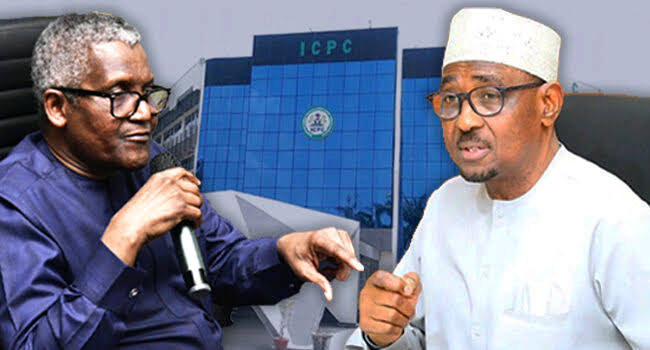
 In a strong and detailed public response, the Managing Director of the Nigerian Midstream and Downstream Petroleum Regulatory Authority (NMDPRA), Farouk Ahmed, has addressed corruption allegations leveled against him by billionaire businessman Aliko Dangote.
This comes after Dangote petitioned the Independent Corrupt Practices and Other Related Offences Commission (ICPC), accusing Ahmed of financial impropriety, including claims he spent $5 million on his children’s education in Switzerland—a sum alleged to be inconsistent with his official income.
In a statement released on Monday, Ahmed defended his three-decade career in Nigeria’s petroleum sector, asserting his commitment to regulatory independence and the national interest.
He described the allegations as a calculated attack motivated by his enforcement of industry reforms that have disrupted established interests.
Key Points from Ahmed’s Response:
1. Education Financing Explained
Ahmed clarified that his children’s education abroad was funded through a combination of merit-based scholarships (40–65% of tuition), family trusts established by his late father, and personal savings accumulated over 30 years of public service. He emphasized that his annual compensation as NMDPRA CEO—approximately ₦48 million—combined with lawful savings and investments, made the expenses feasible without corruption.
2. Invitation for Scrutiny
Ahmed publicly authorized all schools his children attended to release financial records to Nigerian investigators. He also called for a comprehensive review of his asset declarations since 1991 by the Code of Conduct Bureau, the Economic and Financial Crimes Commission (EFCC), and the National Assembly.
3. Regulatory Reforms and Pushback
According to Ahmed, the allegations surfaced shortly after NMDPRA enforced stricter quality standards, transparent licensing, and supply chain reforms—moves he said affected certain market players. He defended the authority’s Q1 2026 import licensing approvals as a statutory duty under the Petroleum Industry Act to ensure supply security, not “economic sabotage.”
4. Defense of Integrity
Ahmed stated he would not be intimidated into granting preferential treatment, insisting that the timing of the allegations was strategic and meant to undermine NMDPRA’s regulatory independence.
“If the price of regulatory independence is personal attacks and manufactured scandals, I accept that price,” he declared.
The response sets the stage for what could become a high-stakes investigation, with Ahmed positioning himself as a reformer facing resistance from powerful interests in Nigeria’s oil and gas sector.