


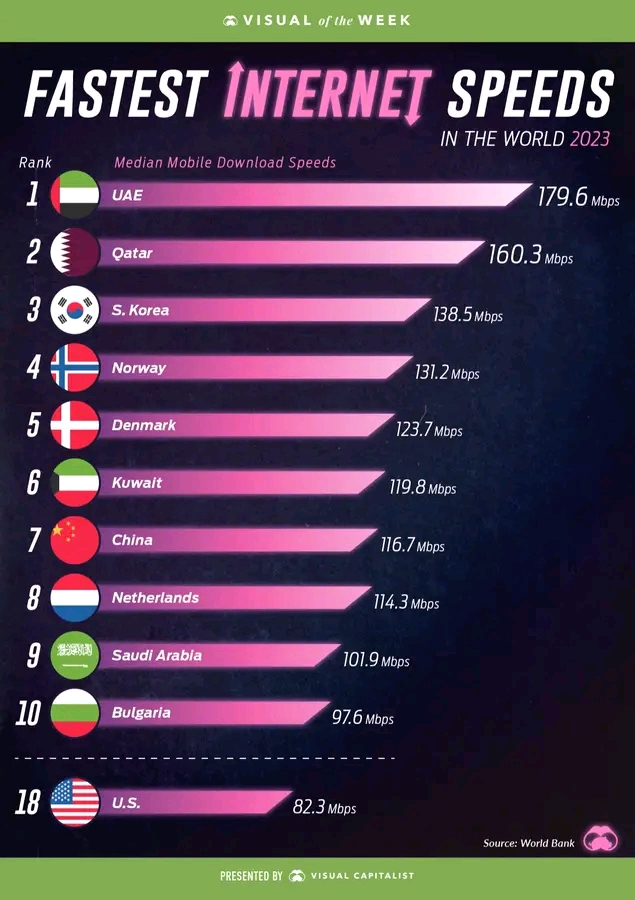
 The United Arab Emirates (UAE) has emerged as the global leader in mobile internet speeds, achieving an impressive average download speed of 179.6 Mbps, according to recent global connectivity reports. Closely following the UAE are Qatar and South Korea, both of which have consistently invested in cutting-edge telecommunications infrastructure to maintain their positions as leaders in digital connectivity.
However, while these nations showcase the potential of mobile internet in driving economic innovation and seamless digital integration, a glaring disparity in internet speeds between high-income and low-income countries reveals a stark digital divide. High-income countries enjoy speeds approximately five times faster than their low-income counterparts, highlighting the persistent inequality in access to robust digital infrastructure.
Notably, the United States, despite its status as a global technological powerhouse, ranks a distant 18th in mobile internet speeds. Experts attribute this underperformance to several structural and policy-related challenges:
- Telecom Monopolies:
In the U.S., a handful of large telecommunications companies dominate the market. This limited competition discourages innovation and keeps service costs high without necessarily improving performance. - High Costs for Consumers:
The affordability of high-speed mobile internet remains a significant barrier for many Americans. Comparatively, residents in nations like the UAE or South Korea often enjoy faster speeds at lower costs, thanks to competitive markets and government-supported initiatives. - Infrastructure Bottlenecks:
While urban areas in the U.S. may experience reasonable speeds, rural and underserved regions continue to struggle with outdated infrastructure and limited connectivity, further widening the digital divide within the country.
Countries like the UAE, Qatar, and South Korea offer a blueprint for success. They have prioritized:
- Significant Investment in 5G: The UAE has heavily invested in 5G infrastructure, allowing for unparalleled speeds and low latency, critical for emerging technologies like autonomous vehicles and smart cities.
- Policy-Driven Innovation: Governments in these nations play an active role in fostering competition among telecom providers while subsidizing the deployment of advanced infrastructure.
- Consumer-Centric Approach: Affordable pricing models ensure that fast mobile internet is not a luxury but a utility accessible to all.
The disparity in mobile internet speeds has far-reaching implications. In high-income nations, rapid internet facilitates innovation, enhances educational access, and boosts economic productivity. Meanwhile, low-income countries are often left grappling with slower speeds that hinder digital transformation and economic competitiveness.
As mobile internet speeds become increasingly critical in a connected world, the U.S. must address its challenges to remain competitive on the global stage. This includes breaking up monopolistic practices, increasing investments in rural broadband expansion, and adopting policies that make high-speed internet more affordable for consumers.
The UAE’s leading position is a testament to the transformative power of prioritizing connectivity. If other nations aspire to similar success, they must take decisive action to bridge the gaps in digital infrastructure and access.