


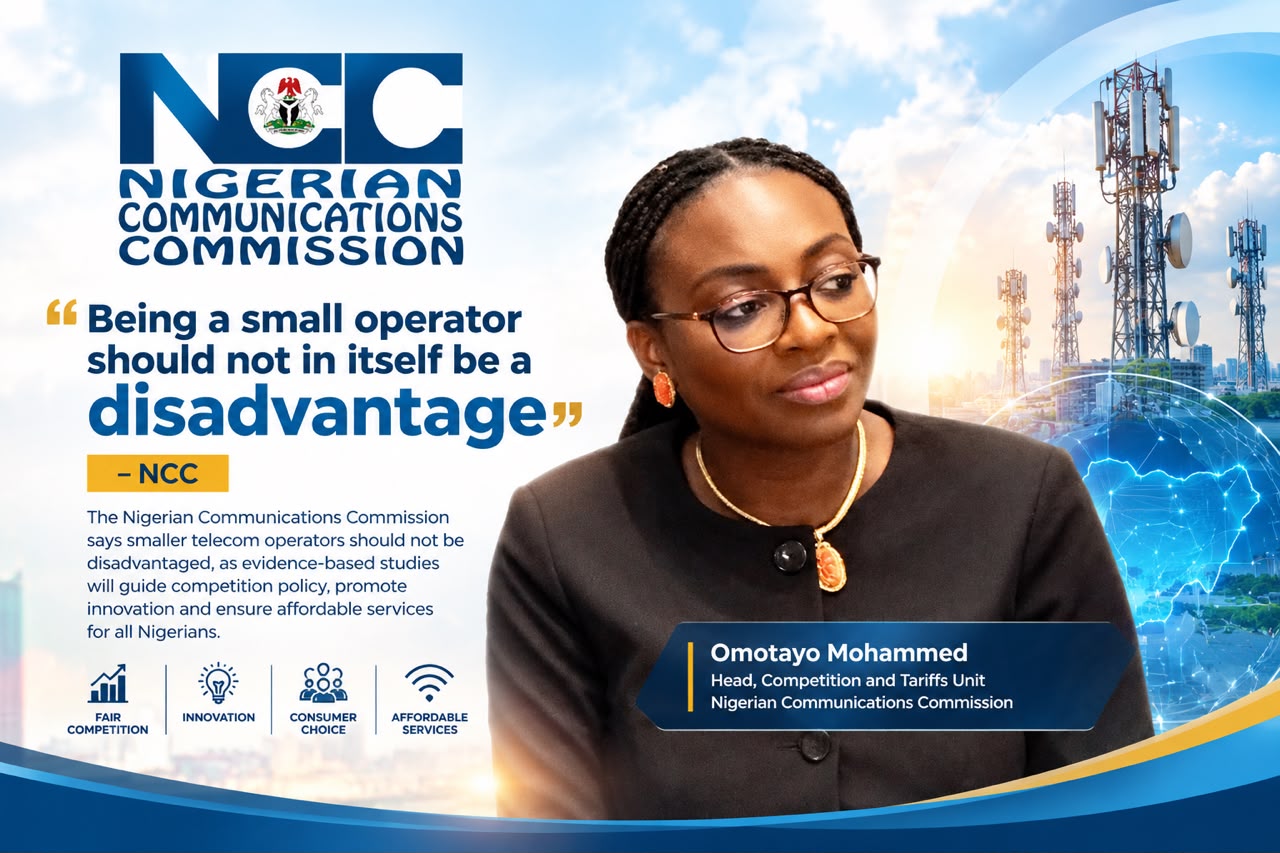
The Nigerian Communications Commission (NCC) says smaller telecom operators should not be disadvantaged because of their size, as it relies on evidence-based research to guide competition policy, encourage investment and promote consumer choice in Nigeria’s telecommunications industry.
At the second NCC Stakeholders Engagement Forum in Lagos, Omotayo Mohammed, Head of Competition and Tariffs, said findings from the Commission’s competition study would help inform targeted regulatory decisions and support a healthier telecoms market.
LAGOS, NIGERIA — The Nigerian Communications Commission (NCC) has reaffirmed its commitment to fair competition in Nigeria’s telecommunications industry, declaring that smaller operators should have opportunities to thrive alongside larger players.
Dr. Aminu Maida, Executive Vice Chairman of the NCC, ably represented at the forum by Mrs. Omotayo Mohammed, Head of the Competition and Tariffs Unit at the Commission, made the position known while addressing journalists at the second NCC Stakeholders Engagement Forum held at the Lagos Continental Hotel, Victoria Island, Lagos, on Wednesday, October 28, 2026.
“Being a small operator should not in itself be a disadvantage to thriving in the industry,” Mohammed said, explaining that the Commission’s regulatory decisions would be guided by evidence, market analysis and the need to protect consumers’ interests.
Her remarks placed the NCC telecom competition study at the centre of the Commission’s efforts to understand market conditions, identify competitive challenges and determine appropriate responses to issues affecting operators and subscribers.
NCC Telecom competition study to guide regulatory decisions
Mohammed explained that competition remains fundamental to the development of the telecommunications sector because it encourages innovation, attracts investment, supports industry sustainability and expands consumer choice.
According to her, the Commission is conducting studies to obtain reliable information that can inform purposeful, targeted and appropriate decisions.
She stressed that the NCC telecom competition study is intended to provide an evidence base for understanding how competition operates across the industry rather than relying on assumptions when determining regulatory interventions.
The approach is significant in a sector where operators compete for subscribers, investment and market opportunities, while consumers expect reliable services, competitive pricing and meaningful choices.
The Commission’s findings and subsequent analysis are expected to help inform its understanding of market dynamics. However, Mohammed did not announce specific new sanctions, tariff changes or regulatory measures at the forum.
Smaller Telecom operators remain important to NCC
Responding to a question about how the Commission intends to address findings relating to smaller operators, Mohammed said the NCC recognises that the size of a company should not automatically prevent it from succeeding in the market.
She explained that any measures adopted would depend on the information collected, the analysis of the findings and the Commission’s understanding of the industry’s competitive environment.
“The smaller players are just as important as the larger players for the NCC,” she said.
The statement signals the regulator’s recognition of the role smaller operators can play in expanding services, introducing new business models and increasing competition.
A market in which smaller players can compete fairly may offer consumers more choices and create incentives for operators to improve their services. The actual effect, however, depends on market conditions, the capacity of operators to invest and the effectiveness of regulatory oversight.
The NCC telecom competition study is therefore an important source of information for assessing whether existing market conditions support fair participation across different categories of operators.
NCC plans further studies across telecom market segments
Mohammed also disclosed that the Commission is pursuing other research initiatives to strengthen its understanding of the telecommunications market.
She referred to proposed studies relating to mobile termination rates and value-added services, explaining that the NCC wants to collect relevant data before making decisions in those areas.
Mobile termination rates concern the charges associated with carrying calls between different networks. Their structure can influence the commercial relationship between operators, particularly where differences in scale and market position affect their ability to compete.
In June 2026, the NCC held a stakeholder consultative forum in Lagos on a review of mobile and international termination rates, with discussions focused on changing economic conditions and developments in telecommunications technology.
The additional research mentioned by Mohammed reflects the Commission’s stated preference for grounding regulatory decisions in data and analysis.
The NCC telecom competition study and related market assessments could help identify where existing arrangements are working, where gaps remain and whether further regulatory intervention is justified.
Fair competition, consumer choice and affordable services
Mohammed linked competition to the wider interests of telecommunications subscribers, noting that the Commission wants consumers to receive the best possible services and enjoy meaningful choices.
The relationship between competition and affordability is important because consumers depend on telecommunications for communication, education, business transactions, digital payments and access to information.
The NCC’s consumer guidance explains that effective competition can encourage better service quality, broaden consumer choice and put pressure on providers to offer competitive services. Its regulatory framework also addresses anti-competitive conduct and the misuse of market power.
While Mohammed emphasised the value of competition, she did not announce an immediate reduction in data prices or other telecom charges at the forum.
Instead, she said the Commission would use information gathered through its studies to inform decisions that support consumers and encourage growth across the industry.
This distinction is important: the forum’s stated purpose was to gather and assess stakeholder input, and the findings of the ongoing study had not been publicly announced in the available reports ahead of the event.
What the NCC Telecom competition study could mean for the industry
The outcome of the research could help the regulator assess competitive conditions and determine whether particular market segments require further attention.
For smaller operators, the central issue is whether market conditions allow them to compete on a fair basis and build sustainable businesses.
For larger operators, the regulatory priority remains compliance with applicable competition rules and the prevention of practices that unfairly restrict other market participants.
For consumers, the expected benefits of effective competition include greater choice, improved services and better value for money.
The NCC’s Policy, Competition and Economic Analysis Department is responsible for assessing competition, monitoring tariffs and anti-competitive conduct, and developing policies to support a competitive telecommunications market.
Nevertheless, the practical impact of the NCC telecom competition study will depend on the quality of its evidence, the conclusions drawn from the analysis and any regulatory actions subsequently adopted.
NCC reiterates commitment to a competitive Telecoms market
Mohammed’s remarks at the second Stakeholders Engagement Forum reinforce the Commission’s stated position that competition should support both industry growth and consumer welfare.
Her assurance that smaller operators matter as much as larger companies places fair participation alongside innovation, investment, service quality and consumer choice as priorities for the sector.
The NCC telecom competition study is expected to contribute evidence that can help the regulator understand market conditions and identify appropriate responses to any problems established by its assessment.
For now, the Commission has outlined its approach rather than announced the final outcome of the study or a new package of interventions.
The central message from Mohammed was clear: an operator’s size should not, in itself, determine whether it has a fair opportunity to thrive in Nigeria’s telecommunications industry.
Published by DASCENARIO
News. Business. Development. Public interest.