
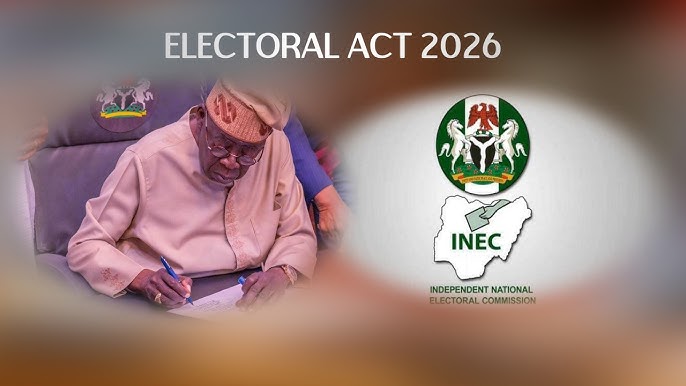
 Abuja, Nigeria – March 8, 2026 – The recent amendment to Nigeria’s Electoral Act has sparked widespread outrage among legal experts, political analysts, and democratic stakeholders following the removal of certificate forgery as a valid ground for challenging election results. Critics warn that the provision could weaken democratic accountability and allow individuals accused of presenting fake academic credentials to remain in office without legal challenge .
Section 138 of the newly amended Electoral Act 2026 outlines the conditions under which an election may be questioned. However, the provision no longer lists certificate forgery among the recognised grounds for filing election petitions .
What the New Law Says
According to the law, an election can now only be challenged on the basis that:
– It was invalid due to corrupt practices or non-compliance with the provisions of the Act, or
– The declared winner was not duly elected by a majority of lawful votes cast .
The amendment further states that actions or omissions that merely contradict the instructions or directives of the Independent National Electoral Commission (INEC), but do not directly violate the Electoral Act, cannot serve as a basis for questioning an election outcome .
In addition, Section 138(3) introduces strict penalties for filing election petitions on grounds not recognised by the Act. The provision mandates courts to impose fines of not less than N5 million on legal counsel and not less than N10 million on the petitioner.
Section 139 also stipulates that an election will not be invalidated on the basis of non-compliance with the law if the tribunal or court determines that the election was conducted substantially in line with the principles of the Act and that any alleged non-compliance did not significantly affect the outcome .
Confirming the removal to BusinessDay, Adedayo Oketola, Chief Press Secretary and Media Advisor to the INEC Chairman, said the provision has been expunged from the amended law. He explained that allegations of certificate forgery now fall within the realm of pre-election matters or intra-party affairs, rather than grounds for questioning the validity of an election before an election tribunal .
Constitutional Conflict?
The amendment has drawn sharp criticism from Senior Advocate of Nigeria (SAN), Jibrin Okutepa, who questioned both the legality and the moral implications of removing certificate forgery as a basis for challenging election results .
In a post on X, Okutepa argued that the National Assembly may have exceeded its powers because issues relating to qualification for public office are constitutional matters. He cited Sections 137(1)(j), 182(1)(j), 107(1)(i) and 66(1)(i) of the 1999 Constitution, which respectively disqualify individuals who present forged certificates from contesting for the offices of President, Governor, and membership of the National and State Houses of Assembly .
“Is the provision of Section 138 of the Electoral Act 2026 not unconstitutional and in conflict with the provisions of the Constitution that prohibit persons who present forged certificates in aid of their qualifications from being qualified for elective offices?” Okutepa asked .
He warned that the development could weaken accountability in the electoral process. “What this means is that those who have forged certificates and who present it to their parties and subsequently to INEC and who win election to any of the above offices can now rule us with forged certificates,” he added .
In a separate statement, Okutepa described the move as an “outrage” and “a brazen attempt to redefine a society’s moral code by a morally compromised political class. When criminals rule, the society’s morals are turned upside down” .
Historical Context
The issue of certificate forgery has deep roots in Nigeria’s political history. Political analyst and professor Jibrin Ibrahim noted that from the very beginning of the Fourth Republic, Speaker Salisu Buhari from Kano State lost his seat in 1999 when it was revealed that he had forged both his age and his claim to being a graduate of the University of Toronto, Canada .
Ibrahim argued that the new law protects politicians with forged certificates. “The issue is very straightforward. Many politicians have been successfully charged to court for presenting forged certificates and they have lost their positions. To protect themselves, they are simply removing the grounds from the law so that they can continue to fake their credentials and remain as elected representatives of the people in spite of their criminal behaviour,” he wrote .
Stakeholders React
Aminu Yakudima, a founding member of the Peoples Democratic Party (PDP), described the development as a serious setback for Nigeria’s democratic and institutional growth. “This is a very serious retrogressive development. It is not good for a country like Nigeria that is still struggling to develop. We are already behind in development, education and human capacity development. If we truly want to grow as a nation, we must place strong emphasis on education, knowledge and experience,” he said .
Similarly, Peter Ameh, a politician and former chairman of the Inter-Party Advisory Council (IPAC), criticised the development as a troubling moment for Nigeria’s democracy. “Why are we sending our children to school? Why are families spending huge amounts of money on education if we are beginning to suggest that academic qualifications no longer matter in public leadership?” he asked .
Former Minority Leader Olorunnimbe Mamora urged Nigerians to challenge the contentious provision in court, warning that failure to do so could pose long-term threats not only to democracy but to the integrity of Nigeria’s academic system .
Prof Ayo Olukoju of the University of Lagos (UNILAG) called on lawmakers to revisit the provision to ensure full constitutional alignment, warning of broader reputational consequences if allegations of certificate forgery are perceived to be shielded from effective challenge .
A Different Perspective
However, Bernard Mikko, a political scientist and former member of the House of Representatives from Rivers State, offered a different perspective. He argued that the issue of certificate forgery is already adequately addressed in the Nigerian Constitution, and therefore removing related provisions from the Electoral Act may not significantly change the legal position .
“Unless the Constitution itself is amended, the fundamental provisions governing eligibility for public office remain intact. If such a clause is removed from the Electoral Act, it does not automatically override what is already provided in the Constitution,” he explained .
Implications for 2027 Elections
Observers say the controversy is likely to intensify debates around electoral reforms and the integrity of Nigeria’s democratic process ahead of the 2027 general elections. The Inter-Party Advisory Council (IPAC) has warned that failure by lawmakers to address the controversial sections could lead to a mass boycott of the 2027 general election .
IPAC has also raised concerns about the NIN requirement in the new Act, warning that it could disenfranchise millions of Nigerians, particularly those in rural and underserved areas .
As the debate continues, legal experts suggest the courts will ultimately have to reconcile the apparent conflict between the Electoral Act and the Constitution. The judiciary, they argue, may interpret Section 138 in a manner consistent with constitutional provisions, or strike down the offending portions altogether .