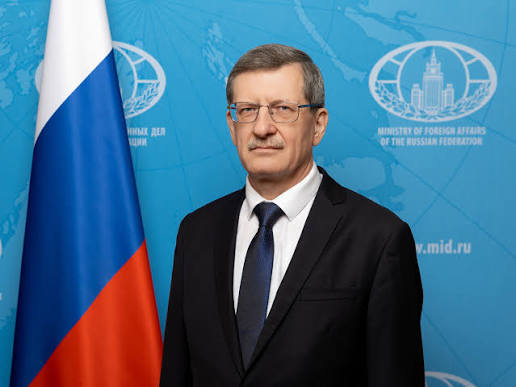
 The Russian Ambassador to Nigeria, Andrey Podyolyshev, has firmly denied allegations of any government-sanctioned programme to recruit Nigerian citizens to fight in Russia’s ongoing war in Ukraine.
Speaking at a press briefing in Abuja on Tuesday, the envoy insisted that if any such recruitment activity exists, it is being conducted by illegal entities operating independently of the Russian state.
“There is no government-supported programme to recruit Nigerians to fight in Ukraine. If there are illegal organisations or individuals trying to recruit Nigerians by unlawful means, this is not connected with the Russian state,” Podyolyshev declared.
His remarks come in response to persistent reports, including a recent CNN investigation, alleging that some Nigerians were deceived into travelling to Russia under the pretext of legitimate security employment, only to receive brief military training and be deployed to the front lines of the conflict in Ukraine.
Moscow Open to Investigating Allegations
The ambassador struck a conciliatory note, expressing Moscow’s willingness to act on verifiable intelligence.
“If anybody has this information, we are ready to send it to Russian law enforcement authorities so they can investigate those cases,” he stated.
He acknowledged that some Nigerian nationals may indeed be present in the conflict zone but maintained that their presence does not constitute evidence of official Russian policy.
Podyolyshev also took aim at Western media outlets, accusing them of a sustained campaign to “demonise Russia.” He urged Nigerian journalists to seek firsthand information by reporting directly from Russia. “You are receiving information from Western sources. Their main task is to demonise Russia. If you want to know the real situation, you should send journalists to Russia to understand what is really happening,” he said.
Strengthening Bilateral Military and Economic Ties
Beyond addressing the recruitment controversy, Podyolyshev used the occasion to outline Moscow’s vision for expanded cooperation with Nigeria across defence, energy, and economic sectors. He revealed that both nations are actively discussing closer defence collaboration, including potential arms supplies and the training of Nigerian military personnel.
“We are discussing the possibilities of supplying Russian weaponry and training military personnel in Russia, maybe here in Nigeria. We are ready to develop cooperation with Nigeria in the military field as much as the Nigerian side wishes. This strengthens Nigeria’s ability to fight terrorism and piracy,” the ambassador stated.
On the economic front, he lamented the stagnation of bilateral trade mechanisms, noting that the last session of the Russia–Nigeria Intergovernmental Commission on Economic Cooperation convened approximately ten years ago. He called for renewed political will to advance major projects. “We need the support of our governments if we want to realise some big projects. Without that support, it is very difficult to move forward,” he said.
Nigeria: A Strategic Partner and Emerging Global Power
Podyolyshev painted a portrait of Nigeria as a nation of rising global significance, describing it as “one of the key states on the continent and the leading link in West Africa.” He highlighted Nigeria’s demographic weight, economic heft as Africa’s largest economy and a major OPEC member, and its proven regional leadership through peacekeeping missions in Liberia, Sierra Leone, and The Gambia.
“Politically, Nigeria is a regional leader, playing a pivotal role in security in West Africa and making a significant contribution to the work of the African Union. For Russia, Nigeria is a partner of strategic importance. Cooperation with Nigeria largely shapes our prospects in West Africa,” he asserted.
Looking to the future, the ambassador framed Nigeria’s ascent as part of a broader shift toward a multipolar world order. “Demography, resources and regional leadership give Nigeria a real chance to become one of the global centres of power in the multipolar world. Russia is interested in Nigeria’s rise, and as Nigeria’s influence grows, the scope for a global Russia–Nigeria partnership will expand,” he said.
Enduring Pillars: Education and Energy
The ambassador reaffirmed that education and energy remain foundational pillars of Russia-Nigeria relations. He noted that thousands of Nigerians were trained in the Soviet Union across engineering, medicine, and other critical fields—a tradition that continues today through annual state scholarship quotas for Nigerian students.
In the energy sector, Podyolyshev pointed to long-term nuclear cooperation as a flagship initiative. “An intergovernmental agreement has been signed on building a Centre for Nuclear Science and Technology in Nigeria with a research reactor and, in the longer term, a nuclear power plant,” he disclosed.
A Vision for a Multipolar World
Concluding his address, Podyolyshev situated Russia’s engagement with Nigeria within its broader foreign-policy doctrine: the pursuit of an international system “free from dictatorship and neo-colonialism.” Such an order, he argued, “creates conditions for stability, development and security for all.”
As Russia seeks to deepen its footprint in Africa amidst intensifying geopolitical competition, Nigeria—as the continent’s most populous nation and largest economy—occupies a uniquely strategic position. The ambassador’s remarks reflect Moscow’s concerted effort to reset and elevate a partnership it views as essential to its continental ambitions.