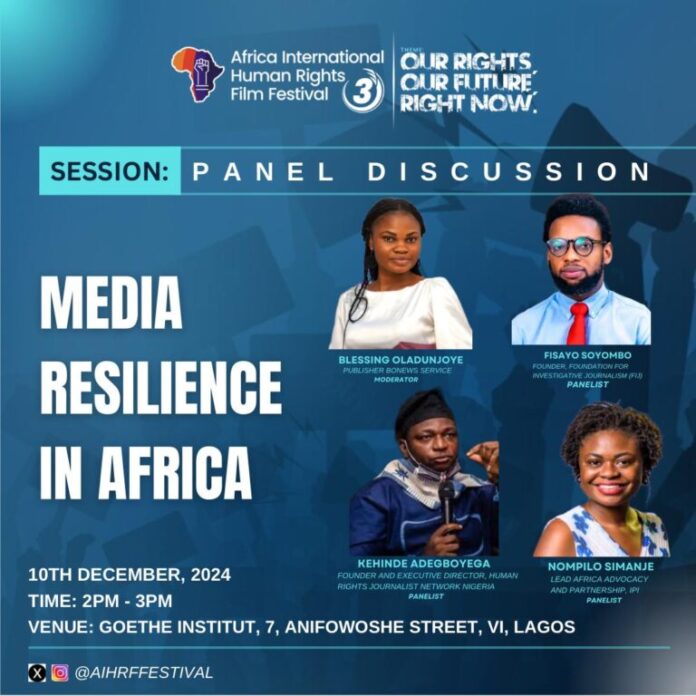
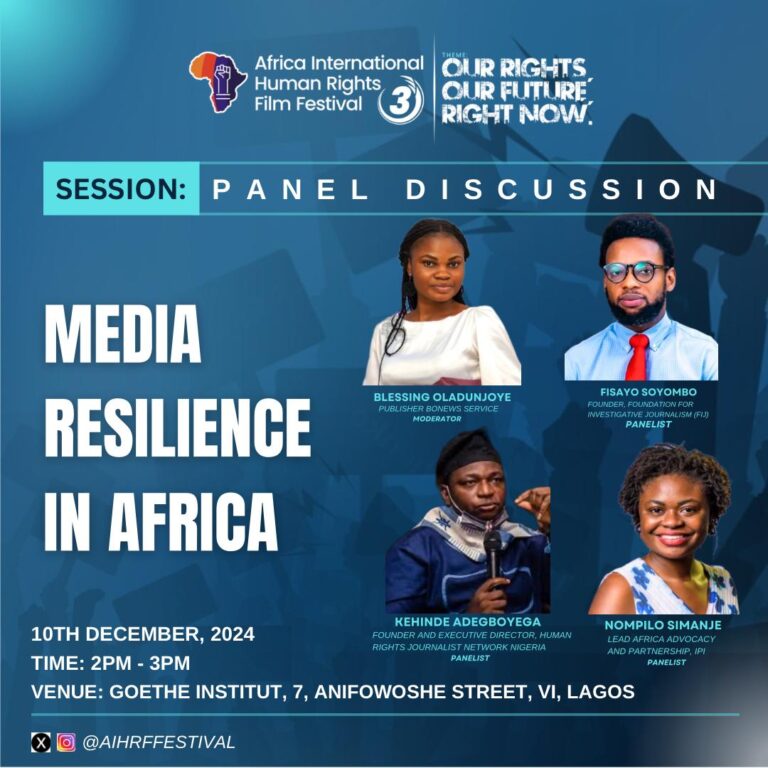
 The Human Rights Journalists Network Nigeria (HRJN), in collaboration with the International Press Institute (IPI), organized a panel session as part of the Africa International Human Rights Film Festival, spotlighting the challenges facing the media in Africa and strategies to enhance its resilience.
The distinguished panelists included:
Fisayo Soyombo, Founder of the Foundation for Investigative Journalism (FIJ).
Nompilo Simanje, Africa Advocacy and Partnerships Lead at IPI.
Kehinde Adegboyega, Human Rights Defender and Executive Director of HRJN.
The session was moderated by Blessing Oladunjoye, Publisher of BONews, a platform dedicated to amplifying underrepresented voices.
Advocating for Press Freedom
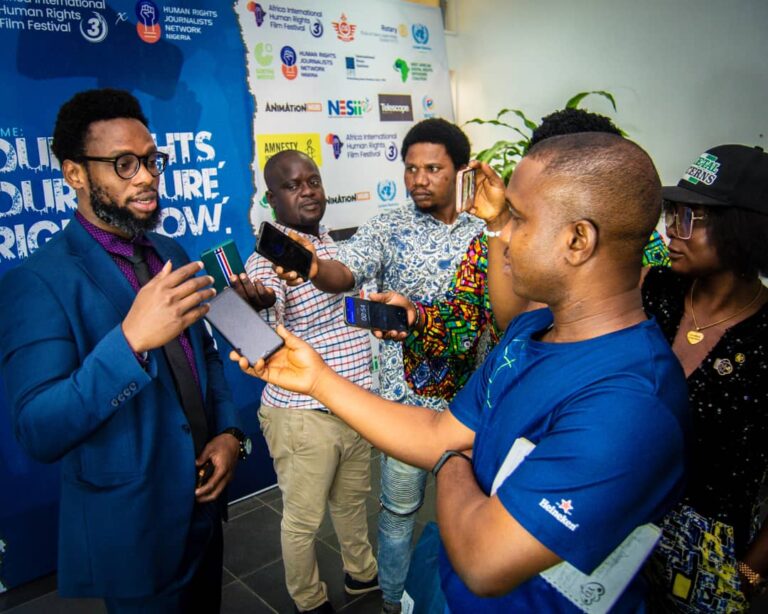
In an interview following the panel, Kehinde Adegboyega emphasized the urgent need to address the repression of journalists in Africa. “Journalists are simply doing their jobs—asking essential questions and holding leaders accountable. Yet, they face threats, intimidation, and even violence for fulfilling this vital role,” Adegboyega remarked.
He further stressed the importance of speaking out against such oppression, regardless of the challenges. “Even if it’s just to rant, we need to let the world know that journalists are being repressed. Press freedom is fundamental, and on a day like International Human Rights Day, it must be highlighted.”
Adegboyega also called for the African Union to establish a dedicated day to combat impunity against journalists. “A formal recognition of the issue by the African Union would underscore the need for stronger protections for journalists across the continent.”
Sustainability and Independence
Addressing the economic challenges facing media organizations, Adegboyega urged the media to embrace digital platforms as a means of achieving financial independence. “The media must creatively explore digital opportunities to remain sustainable and avoid reliance on politicians they are supposed to hold accountable,” he said.
As a human rights publicist with a radical perspective, I must address the systemic failures and exploitation that Nigerian journalists endure daily, particularly in their quest for protection against undue harassment and repression.

The protections currently extended to journalists in Nigeria are largely reactive and superficial, provided only after a crisis erupts. These measures, often tied to the influence of certain power structures, are designed more as temporary sanctuaries than as genuine safeguards for press freedom. Journalists are left vulnerable, forced to navigate a hostile environment without the assurance of meaningful and proactive defense mechanisms.
It is imperative for journalists to demand proactive protection strategies. One such strategy is the establishment of retainership agreements with skilled legal professionals, ensuring immediate and continuous legal support. This step empowers journalists to operate freely without fear of retaliation, thereby strengthening their role as watchdogs of democracy.
The shortcomings of institutional bodies like the Nigerian Union of Journalists (NUJ) and the Nigerian Guild of Editors (NGE) are glaring. These organizations, purportedly established to protect and champion the interests of journalists, have repeatedly fallen short. Their primary focus appears to be self-preservation and internal gains rather than a genuine commitment to defending press freedom. This reality has not escaped the notice of those they claim to represent.
A troubling example underscores this betrayal. A journalist’s work, which had no relation to cybercrime, was manipulated and misrepresented by these bodies, labeling it as such. The affected family fought back, revealing the truth and exposing the organization’s self-serving agenda. Such incidents erode public trust and highlight the urgent need for accountability and reform within these institutions.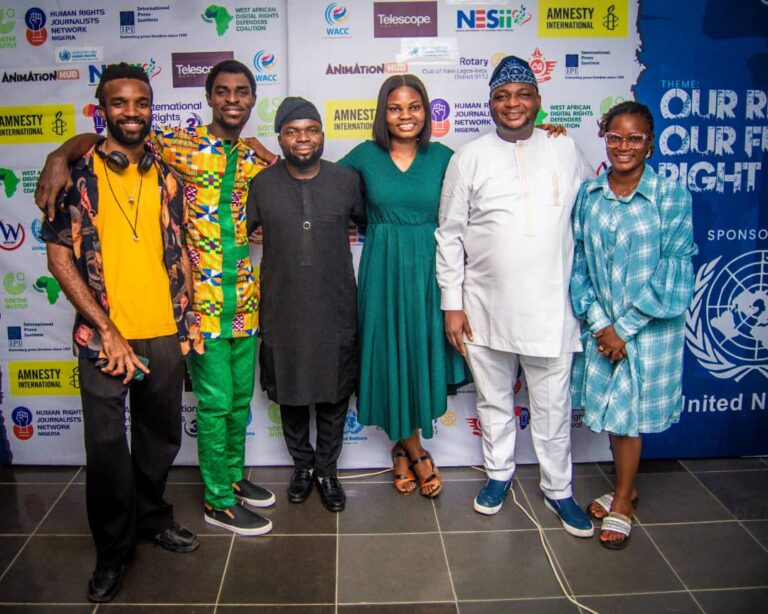
The time has come for journalists to unite, confront these systemic failures, and demand transparent, proactive measures to safeguard their rights. Only through collective action and unwavering resolve can they reclaim their profession from the grip of complacency and corruption.
He underscored the importance of ensuring journalists’ safety to enable them to carry out their duties without fear or compromise. “The oppressed cannot determine how we cry out. When people are suffering under poor economic policies, the press must amplify their voices and demand accountability,” he added.
Renowned investigative journalist Fisayo Soyombo called for a renewed emphasis on media freedom and government accountability. Highlighting the plight of repressed citizens grappling with poor economic policies, Soyombo stressed the vital role of a free press in upholding democracy and human rights.
“The oppressed cannot dictate how I voice my concerns,” he asserted, underscoring the need for journalists to hold leaders accountable while resisting the pressures of censorship and repression.
Addressing the sustainability of independent media, Soyombo urged journalists to harness the opportunities offered by digital platforms. “The media must find creative ways to sustain their operations through digital resources, ensuring independence from the very politicians they are tasked to hold accountable,” he stated.
Reflecting on his own harrowing experience of detention by the Nigerian military, Soyombo shared insights into the risks investigative journalists face. He clarified that his detention stemmed not from wrongdoing but from his role as a journalist uncovering uncomfortable truths.
“I was simply doing my job,” he explained. “Even after presenting evidence of my identity as an investigative journalist, I was kept in detention. It was only the dissemination of information about my arrest that secured my release. Without it, I might still be detained.”
Soyombo highlighted the increasingly precarious conditions for journalists in Nigeria, where courage is a prerequisite for the profession. “Journalists should be focused on ethics, balance, and rigorous reporting, not on the personal risks of publishing a story or the safety of their lives thereafter,” he noted.
The life of an independent journalist, he explained, is far from ordinary. “You forgo normalcy—no clubs, no parties. Your address is often exposed, and every impactful story you publish brings new security threats. The risk analysis never ends.”
Adding to the conversation, Nompilo Simanje, Africa Advocacy and Partnerships Lead at the International Press Institute (IPI), emphasized the legal vulnerabilities of independent journalists. With expertise in media freedom and tech law, Simanje highlighted the critical need for journalists to have access to legal representation.
“Many independent journalists lack personal lawyers to defend them against oppression and repression,” she said, advocating for stronger support networks to ensure that journalists can continue their essential work without fear.
As threats to media freedom grow, voices like Soyombo and Simanje remind the world that the fight for an independent press is not only a fight for journalists—it is a fight for justice, transparency, and democracy itself.
The panel discussion and subsequent conversations reinforced the collective responsibility to safeguard press freedom. From creating sustainable media models to advocating for journalist safety, the event highlighted the critical role of the media in fostering transparency, democracy, and human rights across Africa.
The session served as a powerful reminder that the fight for press freedom is an ongoing struggle—and one that requires the unwavering support of all stakeholders.
– Alfred Abiodun