


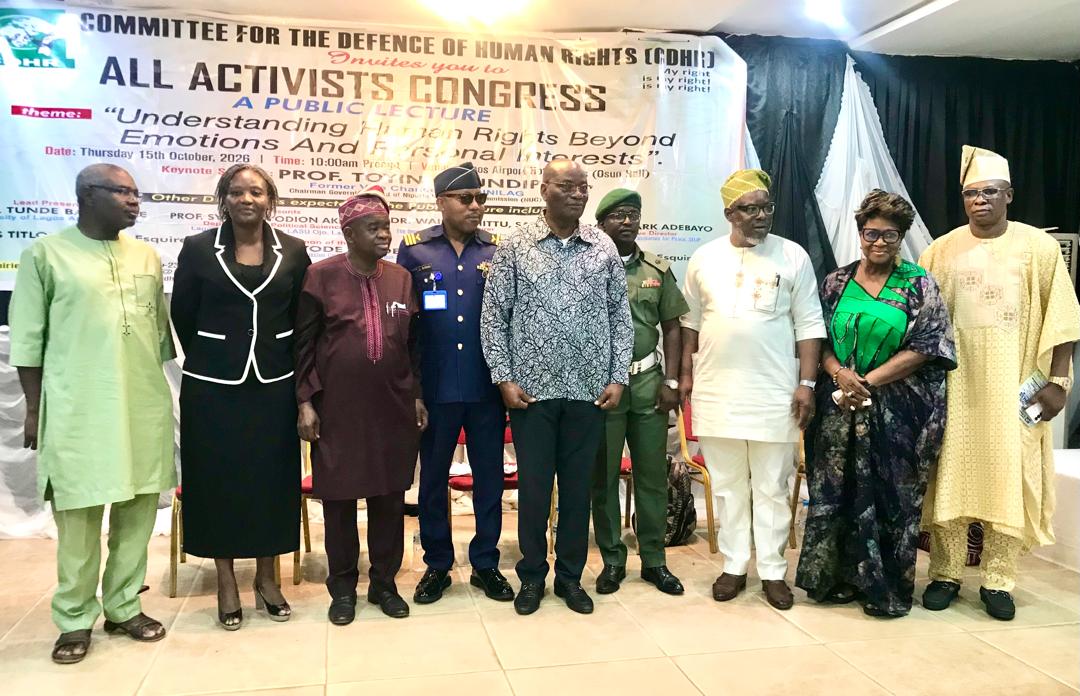
 As she approaches 80 in 2027, MadamYemisi Ransome-Kuti urges Nigerian human rights advocates to embrace accountability, economic development and grassroots participation.
LAGOS, Nigeria — As she approaches her 80th birthday next year, veteran Nigerian civil society leader and Ransome-Kuti family matriarch, Madam Yemisi Ransome-Kuti, has called on human rights advocates to rethink their strategies, strengthen personal accountability and work more closely with the private sector and local communities to advance human rights in Nigeria.
Speaking during a panel session at the Committee for the Defence of Human Rights (CDHR) All Activists Congress public lecture in Lagos on Thursday, October 15, 2026, Ransome-Kuti argued that the changing political environment requires advocates to move beyond the methods used during military rule and adopt approaches that address present-day democratic realities.
The lecture, held at the Osun Hall of Lagos Airport Hotel, Ikeja, was themed “Understanding Human Rights Beyond Emotions and Personal Interests.” Professor Toyin Ogundipe, former Vice-Chancellor of the University of Lagos, delivered the keynote address.
Ransome-Kuti, who was invited to participate in the panel discussion, said human rights advocates must recognise that the struggle for accountability cannot be sustained by demanding responsibility from public officials while ignoring misconduct within their own households, workplaces, businesses and communities.
‘We Must Hold Ourselves Accountable’
Reflecting on the difference between the military era and Nigeria’s current democratic environment, Ransome-Kuti said the opposition during military rule was easier to identify because the military had a defined structure and visible uniforms.
In a democracy, however, she argued, accountability must extend beyond government institutions to society at large.
“The enemy is now everybody,” she said, in a remark about the wider responsibility for upholding standards and protecting rights.
She maintained that advocates cannot credibly hold political leaders accountable if they fail to demand responsibility from their immediate environments.
According to her, ethical conduct in business, entrepreneurship, workplaces and communities gives citizens a stronger foundation from which to challenge abuses of authority.
Ransome-Kuti also urged the human rights community to hold more discussions about how advocacy methods should evolve to meet contemporary challenges.
Human Rights Advocacy Must Address Economic Realities
The veteran civil society leader called for stronger partnerships between human rights organisations and the private sector, describing the latter as an important engine of economic growth.
She argued that rights advocacy must take account of the economic difficulties confronting ordinary Nigerians, including families struggling to pay school fees or meet healthcare costs.
For her, promoting human rights and advancing economic development should not be treated as competing objectives.
Instead, she advocated an approach that combines efforts to institutionalise human rights with practical measures that improve livelihoods and enable citizens to participate more meaningfully in public life.
Her remarks placed economic inclusion and social welfare alongside the traditional focus on civil liberties, legal protections and accountability.
Ransome-Kuti Advocates African-Centred Approaches
Ransome-Kuti also called for a deeper examination of the intellectual traditions that shape human rights and social justice advocacy.
Referring to the ideas associated with Karl Marx and Friedrich Engels, she encouraged advocates to study the origins and meaning of the ideologies that have influenced social movements rather than adopting them without critical examination.
She argued that foreign political and social theories should be assessed in relation to African experiences and cultural values.
Highlighting Ubuntu and the African emphasis on collective responsibility, she said Nigerian advocates should develop approaches that reflect the importance of community, cooperation and carrying people along.
Her position was that effective advocacy requires a thoughtful engagement between global ideas and African social realities, rather than the automatic transplantation of external frameworks.
Local Governments Must Become Centres of Citizen Participation
One of the central themes of Ransome-Kuti’s contribution was the need to strengthen citizen engagement at the local government level.
Drawing on her experience in international development discussions, she said communities often lack sufficient knowledge of the responsibilities of their elected representatives and the different levels of government.
She questioned how many citizens could identify their local government chairmen or explain the responsibilities of local, state and federal authorities.
She described the situation in some communities as one in which people live in “ungoverned spaces,” highlighting gaps in organisation, public awareness and participation.
Ransome-Kuti said she was working with development partners, private-sector stakeholders and chambers of commerce to develop a framework for engagement at the local government level.
She urged human rights advocates to support regular town hall meetings in every local government area, arguing that such platforms could improve public understanding, strengthen accountability and help citizens influence decisions affecting their daily lives.
Citizens Must Be Equipped to Defend Their Rights
Ransome-Kuti stressed that human rights advocacy should not remain the preserve of professionals, campaigners or civil society organisations.
In her view, citizens themselves must possess the knowledge, capacity and interest required to participate in the management of their affairs.
Town hall meetings, community engagement and collaboration among stakeholders, she suggested, could help bridge the gap between rights advocacy and the everyday experiences of ordinary Nigerians.
Her remarks also underscored the importance of helping people understand the responsibilities of public institutions and the avenues available for demanding accountability.
An Enduring Voice in Nigeria’s Civil Society
Ransome-Kuti is a veteran civil society leader and the current head of the Ransome-Kuti family, according to published biographical accounts. Her professional background spans public service, media, international organisations and development work. She has also been associated with the Nigerian Network of Non-Governmental Organisations, which she founded. WISCAR’s profile documents her career and family background.
Her contribution at the CDHR gathering brought questions of democratic accountability, economic development, African values and grassroots participation into a discussion focused on understanding human rights beyond emotions and personal interests.
The broader challenge emerging from her remarks is how Nigeria’s human rights community can translate advocacy into sustained public participation, stronger institutions and practical improvements in people’s lives.
For Ransome-Kuti, that effort begins with accountability at home and in the workplace, extends through partnerships and economic development, and must ultimately reach the local communities where citizens experience government most directly.
Read more news and public-interest reports on DASCENARIO.