

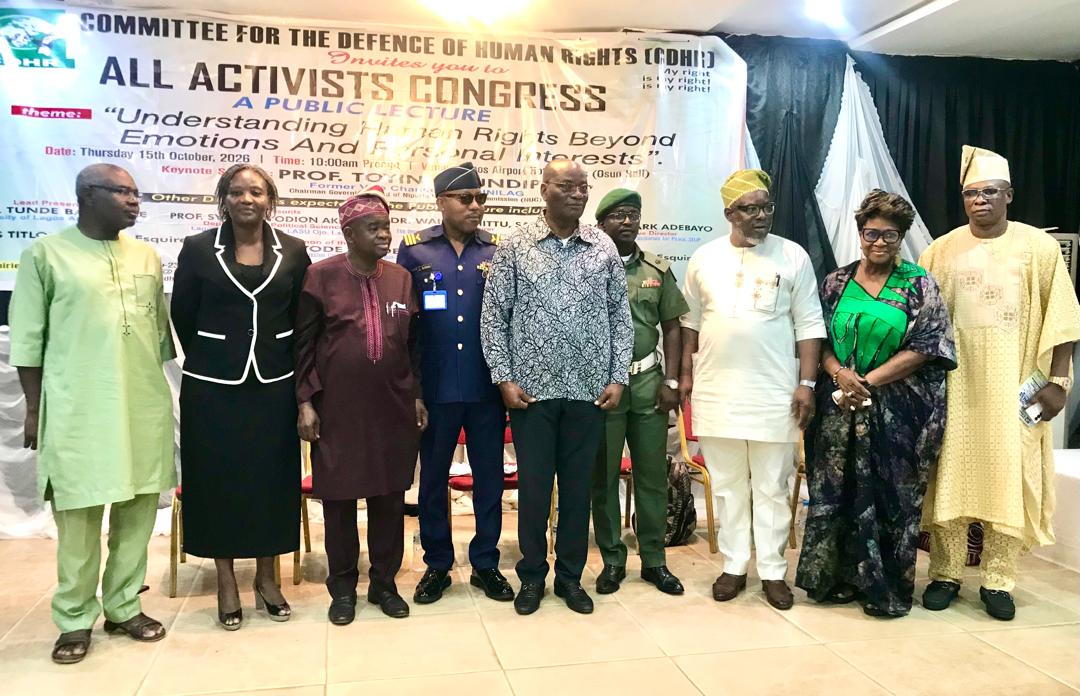
 Academics and human rights advocates at a CDHR lecture in Lagos urged Nigerians to uphold fundamental rights through evidence, legal principles and impartial advocacy.
The CDHR human rights lecture 2026 has brought renewed attention to the need for impartial human rights advocacy, with academics and civil society leaders urging activists to rely on facts, evidence and established legal principles rather than personal interests, political affiliations or emotional reactions.
The public lecture, organised by the Committee for the Defence of Human Rights (CDHR), was held at Lagos Airport Hotel, Ikeja, on October 15, 2026. It was themed “Understanding Human Rights Beyond Emotions and Personal Interests.”
Speakers, including Professor Toyin Ogundipe, Professor Tunde Babawale and CDHR President Comrade Debo Adeniran, argued that human rights must be defended consistently, regardless of the identity, status, beliefs or political affiliations of the people whose rights are at stake.
CDHR Human Rights Lecture 2026: Ogundipe Calls for Evidence-Based Advocacy
Delivering the keynote address, Professor Toyin Ogundipe, former Vice-Chancellor of the University of Lagos, stressed that understanding human rights requires more than emotional expressions or personal opinions.
He said citizens should be able to exercise their rights without oppression or intimidation, while recognising that the exercise of one person’s rights must also respect the rights of others.
Ogundipe also called on government to ensure that overzealous security operatives respect fundamental rights, while urging citizens to understand the limits and responsibilities associated with exercising their freedoms.
He argued that complaints and allegations must be examined through facts, data, applicable laws and due process rather than assumptions.
Using the example of a land dispute involving allegedly forged documents, the professor cautioned that human rights advocates risk undermining justice if they take sides before establishing the facts.
His central message was that human rights protection must be grounded in evidence and fairness, rather than the emotional appeal of an allegation or the identity of the person making it.
CDHR Human Rights Lecture 2026: Debo Adeniran Warns Against Selective Activism
Speaking at the gathering, CDHR President and Board of Trustees Secretary Comrade Debo Adeniran reflected on the organisation’s history and the evolution of human rights activism in Nigeria.
The CDHR was established in April 1989 and developed from a campaign for the release of detained trade unionist and activist Femi Aborisade into a broader human rights organisation.
Adeniran recalled the difficult environment faced by civil society groups during the military administrations of General Ibrahim Babangida and General Sani Abacha, when activists experienced intimidation, detention and restrictions.
He also expressed concern that the ideals that drove earlier generations of activists had weakened, urging contemporary rights advocates to deepen their knowledge and continue their education.
Adeniran’s reflections highlighted the importance of preserving the principles of impartiality, courage and accountability that shaped Nigeria’s historic human rights struggles.
CDHR Human Rights Lecture 2026: Academics Challenge Nigerians to Build the Country
Professor Slyvester Odion Akhanne of the Department of Political Science at Lagos State University urged Nigerian youths to believe in their country and contribute to its development.
Akhanne said that although he had studied in England and secured employment there after completing his education, he chose to return to Nigeria.
He argued that Nigerians should not assume that life abroad automatically offers a stronger sense of belonging or a better future. Instead, citizens should recognise their responsibility to improve their communities and strengthen their country.
He maintained that functional societies are developed through the efforts of their citizens and encouraged Nigerians to become more conscious of the challenges affecting their communities.
Akhanne also called for greater civic awareness and a commitment to national development, saying Nigeria could become a better place through collective responsibility and sustained effort.
CDHR Human Rights Lecture 2026: Babawale Says Activists Must Defend Everyone’s Rights
Professor Tunde Babawale of the Department of Political Science at the University of Lagos challenged human rights activists to defend the rights of people whose views or affiliations differ from their own.
He argued that advocates should be willing to defend the same fundamental rights for their opponents that they demand for themselves.
Babawale’s position underscored the principle that human rights advocacy loses credibility when it is guided by political loyalty, personal interests or selective sympathy.
The discussion also examined the relationship between democratic governance, political leadership and human rights protection.
Babawale argued that Nigeria’s democratic challenges cannot be attributed solely to constitutional provisions, but must also be considered in light of the conduct and character of political elites.
He warned that when public grievances become violent and state responses become more forceful, the resulting cycle can deepen tensions and weaken confidence in democratic institutions.
 CDHR Human Rights Lecture 2026: Human Rights Must Go Beyond Personal Interests
A recurring message from the speakers was that human rights are not privileges reserved for influential individuals, popular causes or people who share the beliefs of those defending them.
Instead, rights advocacy must remain grounded in fairness, evidence, the rule of law and respect for human dignity.
The speakers urged activists to investigate complaints carefully, verify allegations and avoid taking positions based solely on public sentiment or unconfirmed accounts.
They also stressed the importance of understanding the legal framework governing fundamental rights, including the provisions of Chapter Four of the 1999 Constitution of Nigeria, as amended.
The discussion reinforced the distinction between defending a person’s fundamental rights and endorsing that person’s conduct, opinions or political position.
CDHR Human Rights Lecture 2026 Highlights the Role of Government and Security Agencies
The lecture also placed responsibility on public institutions to protect citizens from violations and ensure that government officials operate within the law.
Ogundipe called for government to address misconduct by overzealous security operatives, while speakers emphasised the need for accountability, transparency and fair investigations.
The speakers’ arguments suggested that effective human rights protection requires cooperation among government institutions, civil society organisations, the media, educational institutions and community leaders.
They urged the media to report rights-related issues objectively and encouraged religious and traditional leaders to promote dignity, tolerance, equality and justice.
CDHR Human Rights Lecture 2026 Reinforces the Need for Principled Advocacy
The public lecture concluded with a call for human rights advocates and citizens to apply the same standards of fairness to everyone, regardless of personal loyalties or differences.
The speakers argued that emotional responses can draw attention to injustice, but lasting protection requires evidence, legal safeguards and institutions capable of delivering accountability.
For Nigeria’s human rights community, the challenge is to ensure that advocacy remains consistent, informed and focused on protecting human dignity rather than advancing sectional or personal interests.
The message from the CDHR human rights lecture 2026 was clear: human rights protection becomes meaningful when citizens and institutions defend fundamental freedoms impartially, including when doing so is difficult or unpopular.
For more reports on governance, human rights and public accountability, visit DASCENARIO.