


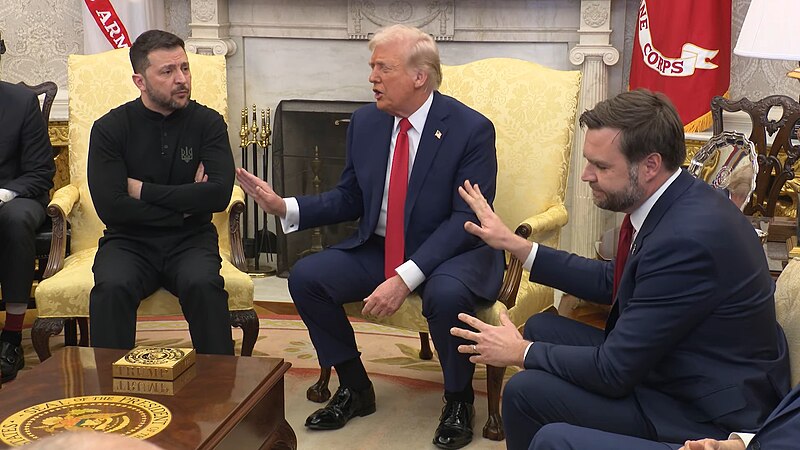
 A recent and highly contentious meeting between U.S. President Donald Trump and Ukrainian President Volodymyr Zelenskyy has precipitated widespread pro-Ukraine demonstrations across the United States. The Oval Office encounter, characterized by heated exchanges, has drawn sharp criticism and raised concerns about the future of U.S.-Ukraine relations.
Oval Office Confrontation
On February 28, 2025, President Zelenskyy visited the White House to discuss ongoing support for Ukraine amid its conflict with Russia. The meeting quickly devolved into a confrontational exchange, with President Trump berating Zelenskyy for perceived ingratitude and implying a potential withdrawal of U.S. support unless Ukraine acceded to certain U.S.-Russia peace terms. This incident marked a significant departure from traditional diplomatic decorum and underscored a shift in American foreign policy.
Nationwide Protests in Support of Ukraine
In response to the contentious meeting, pro-Ukraine rallies erupted across major U.S. cities, including New York, Los Angeles, Boston, and Chicago. Demonstrators expressed solidarity with Ukraine and President Zelenskyy, condemning the Trump administration’s stance and voicing concerns over a potential pivot towards Russia. In San Francisco, the Ukrainian community organized an “emergency rally” to protest the administration’s actions, urging continued support for Ukraine’s sovereignty.
Political Reactions and International Implications
The incident has elicited a spectrum of reactions from U.S. lawmakers. Independent Senator Bernie Sanders condemned Republican calls for President Zelenskyy’s resignation, labeling such suggestions as “horrific” and emphasizing Zelenskyy’s role in defending democracy against Russian aggression.
Conversely, figures within the Trump administration, including National Security Adviser Mike Waltz and Secretary of State Marco Rubio, criticized Zelenskyy for disrupting diplomatic efforts, reflecting a broader shift towards isolationist policies.
Internationally, the confrontation has raised concerns about America’s commitment to its allies and its role in global democratic advocacy. European leaders have expressed strong support for Ukraine, contrasting with the U.S. administration’s recent posture, thereby highlighting potential rifts in transatlantic alliances.
This episode signifies a pivotal moment in U.S. foreign policy, with domestic and international ramifications that could reshape geopolitical dynamics and the global balance of power.