
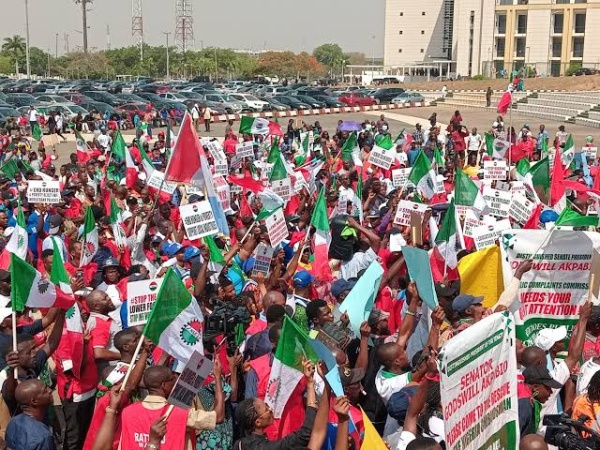
The Nigeria Labour Congress has rejected the Federal Government’s response to its 14-day ultimatum, insisting that minimum wage negotiations begin immediately and that urgent measures be taken to ease workers’ economic hardship.
The Nigeria Labour Congress (NLC) has rejected the Federal Government’s response to its demands for immediate economic relief and the commencement of negotiations for a new national minimum wage, intensifying a dispute that could lead to further industrial action if the two sides fail to reach an understanding.
In a letter dated October 13, 2026, and signed by its President, Joe Ajaero, the Congress faulted the government’s position that negotiations for a fresh minimum wage review would be premature before June 2027.
The NLC insists that preparations for a new wage agreement should begin immediately, alongside measures to reduce petrol prices, provide wage awards and implement outstanding agreements with organised labour.
The dispute follows a 14-day ultimatum issued by the Congress, beginning October 9, which calls on the Federal Government to act on key demands affecting workers’ welfare and the rising cost of living. The deadline is expected to fall on October 22, subject to the Congress’s formal interpretation of the ultimatum period.
FG Says Minimum Wage Review Is Not Yet Due
Responding to the NLC’s demands, Minister of Labour and Employment, Dr Muhammad Maigari Dingyadi, maintained that the current national minimum wage of ₦70,000 became law on July 29, 2024, and would become due for review on June 1, 2027.
The minister said the National Minimum Wage Act, as amended in 2024, provides for a three-year review cycle.
He argued that commencing a fresh review barely two years after implementation would be premature, inconsistent with the law and disruptive to the industrial relations framework established by the legislation.
The government also pointed to existing interventions, including the Presidential Compressed Natural Gas (CNG) Initiative, food security measures and other social support programmes, as efforts to cushion the effects of economic hardship.
Dingyadi said the ministry was engaging relevant ministries, departments and agencies to address other demands within the Federal Government’s jurisdiction. He added that the National Minimum Wage Tripartite Committee would be convened at the appropriate time.
The minister reiterated the government’s commitment to dialogue, decent work and workers’ welfare, urging the Congress to continue engaging constructively.
NLC Disputes Government’s Interpretation of the Law
The NLC rejected the government’s position, arguing that the statutory timeline should be considered in the context of the original National Minimum Wage Act, 2019, and its subsequent amendment.
According to the Congress, the original law was signed on April 18, 2019, and its review timeline meant that a review was due by April 18, 2024.
The labour centre maintains that the 2024 amendment, which increased the national minimum wage from ₦30,000 to ₦70,000 and reduced the review interval from five years to three, did not extinguish the earlier statutory timeline.
The government, however, bases its position on the amended law and the review date it says applies to the current wage arrangement.
The disagreement centres on how the statutory review provisions should be interpreted and when the process for negotiating the next wage agreement should begin.
The NLC argues that negotiations should commence at least six months before the proposed implementation of a new wage to avoid delays and the accumulation of arrears. It says preliminary steps—including calling for nominations, inaugurating a tripartite committee and setting a negotiation agenda—can begin before the new wage becomes due.
The Congress is therefore demanding the commencement of negotiations, rather than the immediate implementation of a new minimum wage.
NLC Says ₦70,000 Wage Has Lost Purchasing Power
Beyond the legal disagreement, the NLC says rising living costs have significantly eroded the value of the current ₦70,000 minimum wage.
The Congress argues that the nominal increase from ₦30,000 has not translated into a corresponding improvement in workers’ purchasing power because of inflation, naira depreciation and higher costs of essential goods and services.
It says many workers are struggling to afford food, housing, healthcare, education and transportation.
The NLC has also criticised the effectiveness of the CNG initiative, arguing that inadequate infrastructure and shortages of gas supplies and vehicle-conversion kits have limited the relief it was expected to provide.
The government, meanwhile, maintains that its CNG, food security and social support programmes are among its efforts to address economic hardship.
The competing positions highlight a wider disagreement over whether existing interventions are sufficient to ease the financial pressure facing workers.
Labour Demands Petrol Price Reduction and Wage Awards
The Congress has asked the Federal Government to take measures to reduce petrol prices to the level prevailing when the current minimum wage was signed into law in July 2024.
It argues that high petrol prices increase transportation costs and push up the prices of food and other essential goods and services.
The NLC is also demanding the implementation of tax relief measures it says were agreed upon in 2023, alongside immediate wage awards to provide temporary support while negotiations for a new minimum wage are prepared.
The Congress maintains that wage awards would help cushion workers against rising living costs during the period before a new wage agreement is concluded.
NLC Seeks Implementation of Outstanding Labour Agreements
The Congress has further called on the Federal Government to implement the terms of settlement with the Joint Health Sector Unions (JOHESU) and address outstanding demands raised by the Joint Public Sector Negotiating Council (JPSNC).
It argues that unresolved agreements and delayed relief measures are adding to workers’ frustration.
The labour centre has warned that further delays could worsen economic hardship and says dialogue must produce definite timelines and practical outcomes.
While its latest letter rejects the government’s response and insists on urgent action, the NLC has not expressly declared an immediate strike in the letter described in the report.
However, the Congress’s earlier ultimatum warned that failure to meet its demands could lead to further action as directed by its relevant organs.
Industrial Tension Depends on Outcome of Further Engagement
The Federal Government and the NLC remain divided over the timing of minimum wage negotiations and the immediate steps needed to ease workers’ economic hardship.
The government insists that the review should follow the statutory timetable under the amended law, while labour argues that preparations must begin early enough to avoid delays and protect workers’ interests.
Attention is now focused on whether further engagement can produce an agreement before the ultimatum expires.
For Nigerian workers, the outcome could affect the timing of future minimum wage negotiations, the prospects for temporary economic relief and the next phase of relations between organised labour and the Federal Government.
Follow DASCENARIO for updates on labour relations, minimum wage negotiations, petrol prices and Nigeria’s economy.