

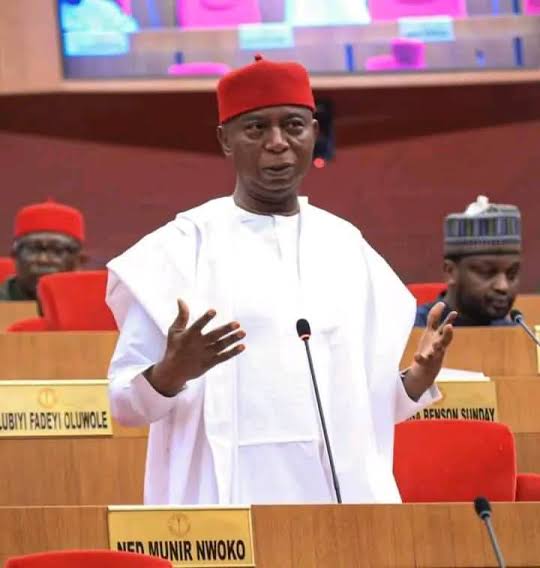
 Senator Ned Nwoko, the lawmaker representing Delta North, has declared that he “feels sorry for men who have only one wife,” framing monogamy as an unstable and unbalanced marital model.
Appearing on Channels Television’s *Politics Today*, the senator, who is publicly married to four wives, including actress Regina Daniels, employed a vivid anatomical analogy to champion his polygamous lifestyle, asserting that having multiple spouses provides a man with greater equilibrium.
“Just imagine standing on one leg — it’s difficult. But with two, three, or four, you’re more balanced. That’s the example I give,” Nwoko stated, offering a rare and unvarnished public justification for a practice that remains both culturally resonant and legally contentious in modern Nigeria.
When confronted with the common argument that the Bible does not endorse polygamy, the senator, who identifies as a man of faith, swiftly countered by referencing the Old Testament’s patriarchal narratives.
However, he quickly dismissed the theological debate as a secondary issue, indicating a preference for personal conviction over religious doctrine in this matter.
With unwavering certainty, Nwoko reflected on his own marital choices, declaring, “No, I don’t have any regret. I would do the same thing again. You should marry who you want to marry.”
This staunch defense was extended to address recent swirling allegations of domestic violence involving his wife, Regina Daniels, which he categorically denied, describing them as “false and unfounded,” and affirming, “I am not a violent person. I respect my wives and love them and my kids.”
The senator’s comments arrive amid a backdrop of reported tension within his household, fueled recently by Regina Daniels’ social media unveiling of a lavish new mansion with the caption, “In my house, I am a queen. I needed a roof over my head, so I got this for me and my family.”
This display of independent acquisition and assertion of queenship has added a complex layer to the public perception of the polygamous dynamic Nwoko so vigorously defends.
His televised remarks have consequently transcended a mere personal justification, plunging directly into a national conversation about marriage, gender roles, cultural traditions, and the evolving definitions of family in contemporary Nigerian society, ensuring his views will be dissected in living rooms and online forums for days to come.