
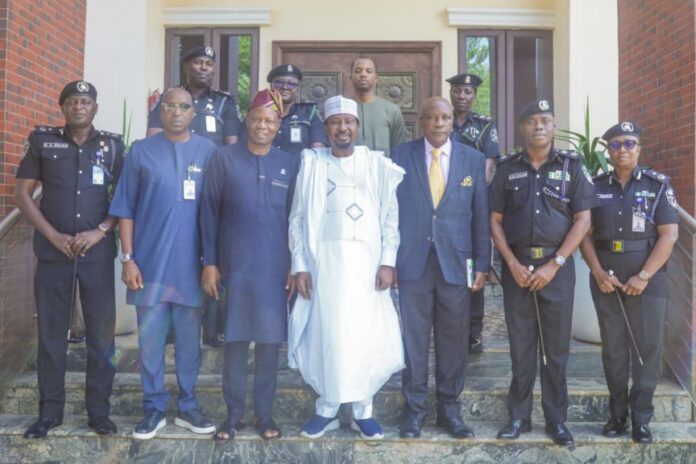
 The push for the establishment of state police structures in Nigeria gathered fresh momentum today as the Deputy President of the Senate, Senator Barau I. Jibrin, met with the Inspector-General of Police’s special committee tasked with developing a national framework for decentralised policing.
The high-level meeting, held in Abuja, signals a critical convergence between the legislative arm and law enforcement authorities on one of the most contentious security reforms in Nigeria’s recent history.
The eight-member committee, inaugurated on March 4, 2026, by the Inspector-General of Police, Olatunji Rilwan Disu, is mandated to design a workable structure for state police aimed at strengthening internal security and improving grassroots law enforcement.
Led by its chairman, Professor Olu Ogunsakin, the committee briefed Senator Barau, who also chairs the Senate Committee on the Review of the 1999 Constitution, on its progress and sought legislative input to enrich its recommendations.
In his response, Barau commended the initiative, aligning it with President Bola Ahmed Tinubu’s Renewed Hope Agenda on national security. He, however, underscored the sensitivity of the proposed reform, stressing that public concerns must not only be acknowledged but decisively addressed.
“You must, most importantly, work on a structure that creates a robust public safety mechanism and engenders a secure nation,” Barau said.
He noted that during recent zonal public hearings on constitutional amendments, Nigerians expressed deep-seated fears about the potential abuse and politicisation of state-controlled policing systems.
According to him, the framework being developed must include strong accountability mechanisms and safeguards to prevent misuse.
“We should create a system that allays their fears,” he added, urging the committee to prioritise transparency, oversight, and public enlightenment in its recommendations.
The meeting comes against the backdrop of ongoing constitutional reform efforts, including a bill seeking to amend the 1999 Constitution to formally establish state and community police structures.
The proposed amendment is designed to enhance local security architecture, deepen community engagement, and reduce the operational burden on the federal police.
In a bid to ensure inclusivity, the Senate Committee on Constitution Review had earlier conducted zonal public hearings across the six geopolitical zones, allowing stakeholders nationwide to contribute to the debate on state policing.